
Introduction
A luxury bathroom renovation in Vancouver involves far more than selecting expensive fixtures. High-end projects typically include custom design, premium tile and natural stone, detailed shower construction, upgraded plumbing fixtures, custom cabinetry, heated floors, layered lighting, and complex installation work that demands skilled tradespeople and careful planning. For homeowners in Point Grey and Shaughnessy – two of Vancouver’s most established residential neighbourhoods – the renovation scope often reflects the scale and character of the homes themselves.
So what does a luxury bathroom renovation cost in Vancouver in 2026? Most luxury primary ensuite projects in Point Grey and Shaughnessy fall roughly between C$65,000 and C$130,000, with many high-end renovations exceeding C$75,000 depending on finishes and scope. Premium or bespoke projects with extensive natural stone, structural changes, and custom millwork can push well beyond $150,000 to $200,000 or more. These are planning-level ranges, not formal quotes – the final cost depends on the specific property’s condition, bathroom size, layout decisions, material selections, and level of customization.
This guide is written for Vancouver homeowners in detached homes and high-end properties in Point Grey, Shaughnessy, and similar neighbourhoods who are considering a luxury or high-end primary bathroom renovation – not a cosmetic refresh or basic update. Costs in these areas tend to run higher than the metro Vancouver average due to several converging factors: Vancouver labour rates are among the highest in Canada, the BC Building Code imposes strict building codes around waterproofing, ventilation, and seismic considerations, and many homes in these neighbourhoods are older structures that require infrastructure upgrades once walls are opened.
What you’ll learn in this guide:
-
Realistic luxury bathroom renovation cost ranges for Vancouver, Point Grey, and Shaughnessy in 2026
-
What drives bathroom renovation cost higher in these neighbourhoods – and what you can control
-
A detailed cost breakdown of where money goes in a luxury bathroom project
-
How to budget, manage timelines, and navigate permits for a major renovation project
-
How to choose a qualified bathroom renovation contractor for high-end work in Vancouver
Understanding Luxury Bathroom Renovations in Vancouver
“Luxury” in the context of a bathroom renovation in Vancouver means more than upgrading a faucet or choosing a more expensive vanity. A luxury renovation typically involves a full gut of the existing space, a custom design process, premium materials throughout (natural stone, large format tile, custom cabinetry), complex shower and tub installations, heated flooring, layered lighting design, and a level of craftsmanship that demands experienced tradespeople and careful project management.
Luxury specifications can be applied to different bathroom sizes – from a compact powder room to a spacious primary ensuite – but the cost impact varies significantly. A powder room renovation with luxury finishes might run $8,000 to $18,000, while a luxury primary ensuite with the same calibre of materials and craftsmanship in a 100+ square foot space will cost many times that amount. The core trades, waterproofing, and installation complexity are required regardless of room size, which is why even smaller luxury bathroom projects carry a substantial per-square-foot cost.
What Counts as a Luxury Bathroom in Point Grey & Shaughnessy?
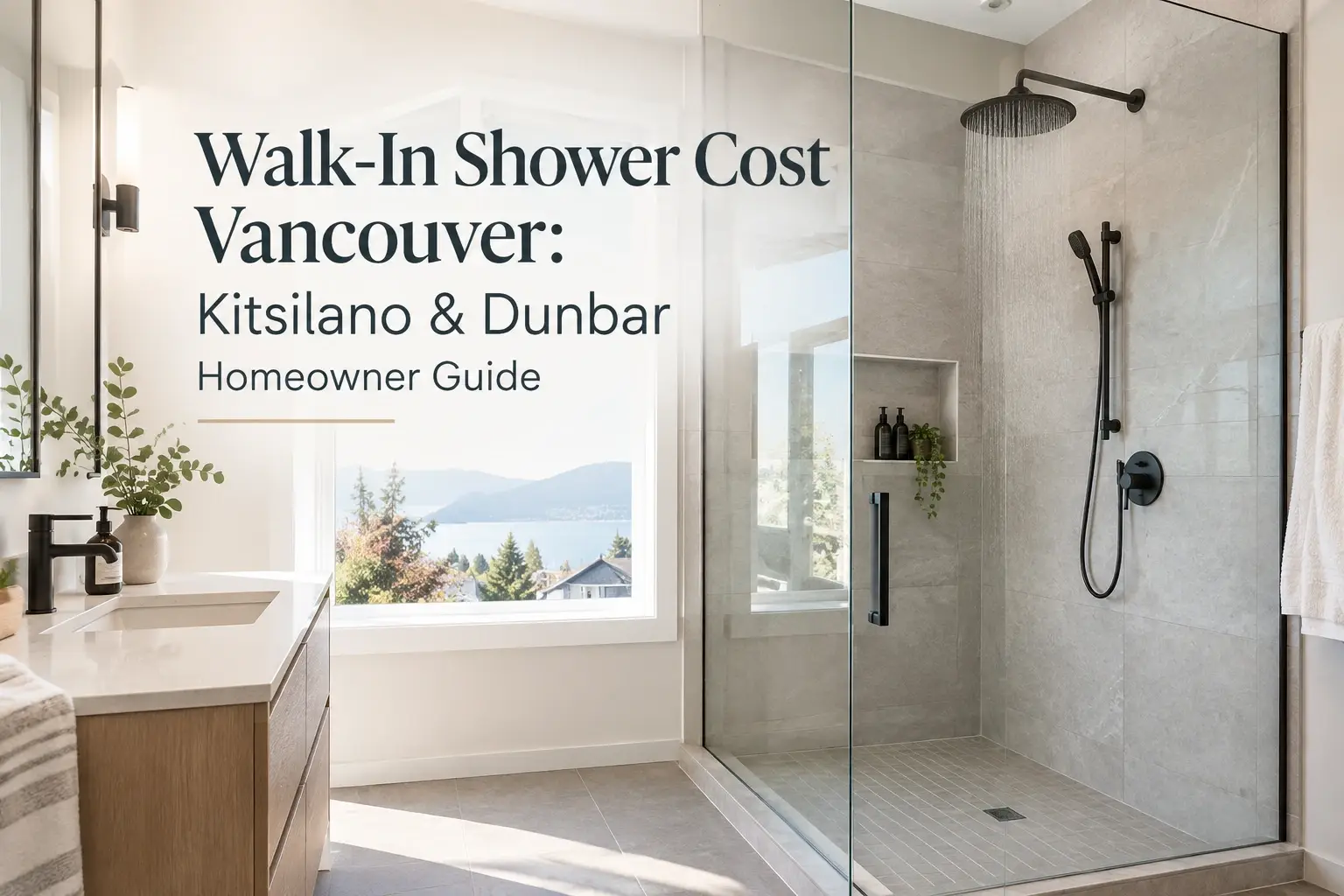
In these neighbourhoods, a luxury primary ensuite bathroom typically includes a large walk-in shower (often curbless with a linear drain), frameless glass enclosure, custom double vanity with integrated storage, natural stone or large format porcelain on floors and shower walls, a freestanding tub or soaker tub, layered lighting with dimmable controls, heated floors, and high-end plumbing fixtures such as thermostatic shower systems with multiple functions.
Room sizes in Point Grey and Shaughnessy detached homes often range from 80 to 160+ square feet for primary ensuites – significantly larger than a typical condo bathroom. That additional square footage opens up options for separate water closets, built-in shower benches, linen towers, and freestanding tubs positioned near windows, but it also means more tile, more glass, more cabinetry, and more labour hours.
Many Point Grey and Shaughnessy homes were built before 1980, and some date back to the early twentieth century. In these properties, achieving modern luxury almost always requires infrastructure upgrades – not just surface changes. Renovating homes built before 1980 often uncovers outdated wiring and hazardous materials. Older homes in Point Grey and Shaughnessy may have outdated plumbing and electrical systems, including galvanized steel plumbing that often needs replacement, and pre-1980 homes often have knob and tube wiring. These realities mean the renovation extends well behind the finished surfaces.
How Luxury Differs from Standard or Mid‑Range Bathroom Renovations
A standard or mid range bathroom renovation in Vancouver might involve replacing fixtures, installing new floor tile and wall tile, updating the vanity, and refreshing the overall look – often while keeping the existing plumbing layout largely intact. Cosmetic updates cost $8,000–$15,000 in Vancouver, and full bathroom renovations range from $10,000 to $20,000 for standard scopes. Mid-range bathroom renovations cost between $25,000 and $45,000, typically with upgraded finishes and some fixture upgrades but limited structural or layout changes.
Luxury bathroom remodels can exceed $65,000 in Vancouver, and the gap between mid range and luxury isn’t just about more expensive products. The difference shows up in design time (weeks of planning, 3D renderings, and material sourcing), labour hours (complex tile patterns, custom shower construction, precise stone fabrication), and technical detailing (in-floor heating integration, custom niches and benches, intricate lighting schemes, bespoke millwork). These qualitative differences are the primary reasons luxury bathroom renovation cost in Vancouver spans such a wide range.
How Much Does a Luxury Bathroom Renovation Cost in Vancouver?
Now that we’ve defined what luxury means in a Vancouver context, here’s how that translates into practical planning-level cost ranges for 2026. These ranges are intended for detached homes and reflect the kind of scope commonly seen in Point Grey, Shaughnessy, and similar metro Vancouver communities. They are not formal quotes – actual pricing varies by contractor, project scope, property conditions, and material selections.
Planning-Level Cost Ranges (2026)
High-end bathroom renovation (upper mid to high range): Roughly $45,000 to $80,000 for a typical 3-piece or compact ensuite with upgraded finishes but limited layout changes. At this level, homeowners typically receive quality porcelain or large format tile on floors and shower walls, a frameless glass shower enclosure, a new vanity (often semi-custom or custom), upgraded plumbing fixtures, heated floors, and improved lighting – but the existing plumbing layout is generally preserved. The room size is often 50 to 70 square feet.
Luxury bathroom renovation: Roughly $65,000 to $130,000+ for a full gut renovation of a primary ensuite. This tier includes a custom double vanity, a large custom shower (often curbless with linear drain, rain head, handheld, and body sprays), a freestanding tub or soaker tub with dedicated tub filler, premium bathroom tile (natural stone or high-end porcelain), heated flooring, custom cabinetry with soft-close hardware and built-in organizers, layered lighting with dimmers, and full waterproofing systems. Moderate plumbing relocation and some electrical upgrades are common. Room sizes typically range from 80 to 120 square feet. Luxury bathroom renovations in Point Grey and Shaughnessy typically range from C$65,000 to C$130,000, and luxury bathrooms frequently include premium features such as curbless showers and heated floors.
Premium/custom luxury bathroom renovation: Roughly $110,000 to $200,000+ for very large primary suites exceeding 120 square feet with extensive natural stone (full slab walls, stone shower benches, stone thresholds), top-tier plumbing packages (thermostatic multi-head showers, smart toilets, floor-mounted tub fillers), custom millwork and detailed panelling, structural changes (moving walls, enlarging windows, reinforcing floors for heavy stone), and the highest level of custom fabrication and finishing. These projects involve significant design, project management, and skilled installation time.
Powder room renovations typically range from $5,000 to $12,000, while master ensuite renovations at standard specification typically cost $20,000–$35,000. The luxury tiers above reflect the additional scope, materials, and craftsmanship that high-end projects demand.
Why Luxury Bathrooms Have a Wider Price Range Than Standard Projects
Two luxury bathrooms of similar size can differ by $50,000 or more. The range is driven by personalized design decisions, bespoke details, imported or natural materials, and the degree of plumbing and electrical relocation required. Installation complexity is a major factor: book-matched marble slabs, herringbone shower tile patterns, curbless showers with precise slope engineering, and custom glass templating all require substantially more skilled labour hours than straightforward installations.
Materials and finishes can significantly impact the renovation budget, but so can the condition of the home behind the walls. Point Grey and Shaughnessy add extra variables due to their larger room sizes and older structures, which we’ll explore in the next two sections.
Luxury Bathroom Renovation Cost in Point Grey
Point Grey’s housing stock includes a mix of 1920s–1960s character homes, mid-century properties, and some newer builds. Many of these detached homes have generous primary suites, and homeowners here typically expect finish levels that match the home’s value and the neighbourhood’s standards. Bathroom size and existing infrastructure drive costs more than the neighbourhood name alone, but Point Grey homes often feature larger ensuites and higher finish expectations than the average bathroom renovation in Vancouver.
Typical Point Grey Luxury Bathroom Cost Ranges
For planning purposes, luxury bathroom projects commonly seen in Point Grey fall into these approximate ranges:
-
High-end 3-piece or compact ensuite: Roughly $45,000 to $75,000, with upgraded finishes, quality tile, a frameless glass shower, and a custom or semi-custom vanity, but limited layout changes.
-
Luxury primary ensuite with large shower and double vanity: Roughly $70,000 to $130,000+, including heated floors, premium stone or porcelain, custom cabinetry, and possibly moderate plumbing relocation.
-
Ultra-custom suites in larger homes: Can exceed $150,000+ depending on the extent of natural stone, custom millwork, structural modifications, and specialty plumbing fixtures.
Many Point Grey projects include features like walk-in showers with multiple shower heads, heated floors extending into connected dressing areas, and custom cabinetry with built-in storage towers and drawer organizers – all of which push costs upward.
Point Grey Home Characteristics That Influence Cost
Detached homes in Point Grey often have larger primary suites, and more square footage means more tile, more glass, more cabinetry, and more labour. A 120-square-foot ensuite requires significantly more material and installation time than a 60-square-foot bathroom, even at the same quality level.
Older homes in Point Grey frequently have outdated plumbing – galvanized steel or Poly-B piping – and electrical systems that may not support modern fixture loads. Homes built before the 1980s may need electrical panel upgrades, new circuits with GFCI protection, and updated ventilation to meet current code requirements. Older homes frequently reveal hidden water damage during renovations, and renovating older homes typically requires a 15–20% contingency budget to address these discoveries.
Some Point Grey homes have had multiple previous renovations over the decades, which can introduce additional surprises once walls are opened – mismatched framing, improvised plumbing connections, or inadequate waterproofing from earlier work. The generous floor plates in these homes also create opportunities for layout re-planning, but moving walls or expanding into adjacent closets involves structural work that adds to the renovation cost.
Luxury Bathroom Renovation Cost in Shaughnessy
Shaughnessy is home to some of Vancouver’s most substantial residential properties – heritage and estate-style homes with large footprints, formal primary suites, and high expectations for finishes and craftsmanship. While many projects here are top-tier, some homeowners choose restrained, timeless updates rather than ultra-luxury specifications. Not every Shaughnessy home requires the same scope, and renovation costs reflect the individual property’s age, size, condition, and the homeowner’s design goals.
Typical Shaughnessy Luxury Bathroom Cost Ranges
Approximate 2026 planning-level budgets for luxury bathroom work in Shaughnessy:
-
High-end bathroom in a secondary suite or guest room: Roughly $50,000 to $85,000, with premium tile, quality fixtures, and custom or semi-custom cabinetry.
-
Luxury primary ensuite in a heritage or estate home: Roughly $80,000 to $150,000+, including natural stone, custom double vanity, large walk-in shower, freestanding tub, heated flooring, and layered lighting.
-
Full custom, stone-heavy, millwork-intensive suites with multiple zones: Can reach $180,000 to $220,000+ depending on structural updates, imported materials, and the level of bespoke detailing.
Natural stone (marble, limestone), custom millwork, and large frameless glass assemblies are especially common in Shaughnessy luxury bathrooms and are major cost contributors. Renovations in these neighbourhoods align with Vancouver-wide luxury price ranges, though the scale and formality of the homes often push projects toward the higher end.
Shaughnessy Home Characteristics That Influence Cost
Many Shaughnessy homes feature heritage or character elements – panelled walls, leaded glass, plaster details, thick mouldings – that need to be protected or thoughtfully integrated into a modern bathroom renovation. Custom carpentry to match existing architectural trim is more expensive than standard finishing work.
Larger room volumes, higher ceilings, and long wet walls increase both material quantities and labour hours. Structural implications arise when reconfiguring historic layouts, reinforcing floors for heavy stone tubs, or modifying exterior openings. Not all Shaughnessy homes are heritage-listed, but many are older, so existing plumbing, electrical, and ventilation systems often need assessment and potential upgrades. Heritage properties need a heritage alteration permit for exterior changes, which adds a layer of planning and permit processing time.
Luxury Bathroom Renovation Cost Breakdown
Understanding where the money goes in a luxury bathroom renovation helps homeowners compare quotes, set priorities, and make informed trade-offs. This breakdown applies broadly across Vancouver luxury bathroom projects, with particular relevance to the larger, more complex renovations common in Point Grey and Shaughnessy.
Major Cost Categories
The following categories represent where the renovation budget is typically allocated. Approximate proportions vary by project, but these are the components that make up the final cost:
-
Design and planning: Interior design fees, architectural drawings, site measures, 3D concepts. Often 5–8% of the total budget for custom projects.
-
Demolition and debris removal: Tear-out of existing finishes, protective measures for the rest of the home, and disposal – including hazardous material abatement if older homes contain asbestos in materials.
-
Plumbing: Plumbing rough-in, fixture connections, drain and vent work, and any plumbing relocation. Plumbers charge $100–$150 per hour in Vancouver, and moving plumbing fixtures adds $2,000 to $12,000 to costs depending on complexity.
-
Electrical and lighting: New circuits, lighting layout, GFCI outlets near water, heated floor wiring, and possible panel upgrades. Electrical permits are needed for new circuits or panel upgrades.
-
Ventilation: New or upgraded exhaust fans with proper CFM ratings, ducting to exterior, and possible HRV tie-in for larger renovations.
-
Waterproofing and subfloor prep: Membrane systems (e.g., Schluter or liquid-applied), proper slope to drain, backer board installation, and subfloor repair or reinforcement under heavy stone or large tubs.
-
Flooring and wall tile: Materials and professional tile setting labour for floor tile, wall tile, and shower tile. This includes substrate preparation, layout planning, and grouting.
-
Natural stone: Stone slabs, shower benches, thresholds, and feature walls – plus fabrication and specialized installation.
-
Shower construction: Shower pan, curbless design engineering, linear drains, built-in niches, benches, and glass blocking.
-
Plumbing fixtures: Shower systems (thermostatic valves, rain heads, body sprays, handheld), faucets, tub fillers, toilets, and specialty drains.
-
Bathtub: Freestanding tub, alcove tub, or custom installation – acrylic, cast iron, or stone composite.
-
Vanity and custom cabinetry: Custom or semi-custom vanity, linen towers, medicine cabinets, internal organizers, and moisture-resistant construction.
-
Countertops and sinks: Stone countertops (quartz, porcelain, or natural stone), integrated sinks, and undermount installations.
-
Lighting and mirrors: Recessed lights, sconces, backlit or anti-fog mirrors, cove lighting, and dimming controls.
-
Heated flooring: Electric mat systems, thermostats, and integration with the tile assembly.
-
Glass shower enclosure: Frameless glass panels, custom door hardware, heavy-duty hinges, seals, and steam shower options where applicable.
-
Hardware and accessories: Towel bars, robe hooks, grab bars, shower accessories, and toilet paper holders.
-
Painting and finishing: Walls, ceiling, trims, and touch-ups elsewhere in the home if affected by the renovation.
-
General labour and project management: Site supervision, trade coordination, inspections, scheduling, and communication. Specialized labor represents 40% to 65% of the total renovation budget, and labour accounts for 40–50% of renovation costs overall. Demand for skilled trades in Vancouver significantly increases labor rates.
-
Permits and inspections: City of Vancouver building permits, plumbing and electrical trade permits, and required inspections. Permit fees range from $900 to $1,300 for mid-range renovations.
The categories with the biggest budget impact in luxury projects are typically tile and natural stone, plumbing and electrical (especially when relocation is involved), custom cabinetry, and glass enclosures. Luxury bathrooms often require substantial project management and detailed design work, which also contributes meaningfully to the overall cost.
What Makes a Luxury Bathroom Renovation More Expensive?
Two bathrooms of similar size can differ by tens of thousands of dollars based on decisions behind the walls and in the design details. Understanding these cost drivers helps homeowners make deliberate choices about where to invest.
Construction & Layout Factors
-
Plumbing relocation: Relocating drains, vent lines, and supply pipes – such as converting a tub to a walk-in shower or adding a separate water closet – is one of the most significant single-item cost increases. The existing plumbing layout heavily influences the base cost of any renovation.
-
Structural changes: Moving or removing walls, expanding into adjacent rooms or closets, and reinforcing floors for heavy stone tubs or slab installations. These changes typically require engineering review and building permit approval.
-
Hidden conditions: Older homes frequently reveal hidden water damage during renovations, along with rot, mould, or uneven subfloors once demolition begins. Home renovations in luxury neighbourhoods often encounter older home complexities that weren’t visible during planning.
-
Electrical upgrades: Replacing outdated wiring (including knob and tube wiring in pre-1980 homes), adding new circuits for heated floors and upgraded lighting, and ensuring GFCI and arc-fault protection meets current code.
-
Ventilation improvements: Upgrading undersized or non-existent exhaust fans, extending ductwork to exterior walls, and ensuring the system meets BC Building Code requirements for moisture control.
Material & Design Choices
-
Premium tile and natural stone: Complex patterns (herringbone, chevron, mosaics) and slab installations require significantly more cutting, fitting, and waste than standard layouts. Book-matched marble slabs involve careful sourcing and precise fabrication.
-
Custom cabinetry and millwork: Built-in niches, window seats, intricate panelling, and custom vanities with specialized storage all require more design time, fabrication, and on-site fitting than stock or semi-custom options.
-
Frameless glass: Custom steam showers, oversize glass panels, and frameless enclosures requiring on-site templating cost substantially more than standard framed units.
-
High-end plumbing fixtures: Thermostatic valves, multi-function shower systems, smart toilets, and floor-mounted tub fillers carry higher material costs and often require more complex installation.
-
Smart technology and integrated controls: Lighting automation, floor heat controls, speakers, and smart mirrors add both product cost and wiring complexity.
A large part of the cost in luxury bathroom renovations is skilled installation time – not just the price tag of materials. The same stone slab costs far more to install as a book-matched feature wall than as a simple vanity top, even though the material price per square foot may be similar.
Luxury Materials: Where Should Homeowners Spend More?
Not every line item in a luxury bathroom needs to be the most expensive option available. This section helps Vancouver homeowners prioritize their renovation budget in a way that delivers lasting quality and visual impact.
High-Impact / High-Priority Investments
-
Waterproofing systems and membranes: This is the single most important investment in any bathroom. Waterproofing failures in multi-storey Point Grey or Shaughnessy homes can cause catastrophic damage to floors, ceilings, and structural elements below – repairs that cost far more than doing it right the first time.
-
Core plumbing components: Valves, drains, and supply lines that will be buried behind walls and under floors. Quality here means long-term reliability and fewer emergency repairs.
-
Professional tile installation: The quality of the substrate, the skill of the tile setter, correct use of expansion joints, and proper waterproofing integration matter more than the tile itself. Poor installation can ruin expensive stone or porcelain.
-
Durable flooring: Vancouver’s damp coastal climate demands flooring materials and installation methods that resist moisture over time.
-
Quality cabinetry construction and hardware: Moisture-resistant cabinet boxes, soft-close hardware, and solid drawer construction withstand daily bathroom use far better than budget alternatives.
-
Shower systems and faucets: These are used daily, and inexpensive valves and cartridges can fail within a few years. Upgraded plumbing fixtures from established manufacturers are worth the investment.
Aesthetic Upgrades & Where to Mix Tiers
-
Natural stone vs. high-end porcelain: Natural stone makes a strong statement as a feature wall, vanity top, or shower bench, but high-end porcelain can be highly practical for high-traffic floors and large shower walls where maintenance and durability matter. Mixing the two is a common strategy in luxury Vancouver bathrooms.
-
Statement tile used sparingly: A single dramatic accent wall, a detailed niche, or a patterned shower floor can anchor the design without requiring premium material on every surface. Simpler field tile elsewhere helps control material costs.
-
Designer hardware and lighting: These function as the “jewelry” of the space. Premium towel bars, robe hooks, sconces, and a beautiful mirror can elevate a bathroom with more modest wall surfaces, delivering strong visual impact for a relatively contained cost.
Encourage homeowners to choose a few focal luxury elements that align with how they’ll use the space daily, rather than defaulting to the most expensive option in every category.
Luxury Bathroom Design Ideas for Point Grey & Shaughnessy Homes
Design direction in these neighbourhoods should respond to the scale and architecture of the home. Both Point Grey and Shaughnessy feature larger properties where bathrooms can be designed as genuine retreats rather than purely functional rooms.
Design Directions That Suit Larger West Side Homes
-
Large walk-in showers with bench seating, linear drains, and recessed niches – designed with generous proportions that suit taller occupants and aging-in-place considerations. Multiple shower functions (rain head, handheld, body sprays) with thermostatic controls are increasingly expected.
-
Freestanding tubs positioned near windows with privacy glass or well-planned landscaping, creating a focal point that takes advantage of the room’s proportions.
-
Double vanities with integrated storage towers, pull-out organizers, and drawer dividers – providing the kind of organized, functional storage that makes daily use comfortable.
-
Heated porcelain or stone floors, possibly extended into connected dressing areas, providing comfort during Vancouver’s cooler months.
-
Layered lighting combining ambient ceiling lights, task lighting at the vanity, and accent lighting in niches or under-cabinet strips – all on dimmers for flexibility throughout the day.
Homeowners researching design ideas and cost considerations for luxury bathroom projects may find it helpful to explore resources like 4 Local Homes before meeting with a designer or contractor, to develop a clearer picture of scope and priorities.
Modern Luxury vs. Timeless Luxury Bathroom Design
Point Grey and Shaughnessy homes can work with either modern or traditional aesthetics – the right approach depends on the home’s architecture, the owner’s preferences, maintenance expectations, and long-term plans.
Modern Luxury Bathrooms
Modern luxury bathrooms are characterized by flat-panel or floating vanities, large format tile with minimal grout lines, frameless glass, linear drains, integrated LED lighting, and minimal visible hardware. The result is a visually open, clean-lined space that feels spacious and easy to maintain.
This approach works well in newer contemporary builds and significant interior remodels where the home’s overall aesthetic leans modern. The primary consideration is that strongly trend-driven choices can feel dated as styles evolve, and minimalist designs require thoughtful storage planning to avoid visual clutter.
Timeless / Traditional Luxury Bathrooms
Timeless luxury bathrooms feature panelled or detailed cabinetry, classic marble or marble-look surfaces, traditional sconces, clawfoot or pedestal tubs, architectural trim, and warmer hardware finishes. These designs align naturally with character and heritage homes common in Shaughnessy and older Point Grey properties.
The primary consideration is that more intricate detailing raises labour cost – detailed mouldings, wainscoting, and panelled vanities require skilled carpentry. Material choices also matter: real marble, while beautiful, requires more maintenance than engineered alternatives.
The best approach often depends on the home’s existing character. A 1930s Tudor in Shaughnessy may benefit from a bathroom that echoes its architectural details, while a mid-century Point Grey home might suit a cleaner, more contemporary treatment. Consider long-term maintenance tolerance and whether the design will feel coherent with the rest of the house.
Renovating a Luxury Bathroom in an Older Point Grey or Shaughnessy Home
Many of the most rewarding luxury bathroom renovations in Vancouver happen in older homes – but these projects require thorough early investigation. The charm and scale of pre-1980 or heritage-style homes come with infrastructure realities that directly affect scope, timeline, and budget.
Common Older-Home Conditions to Check
-
Aging plumbing: Galvanized steel, cast iron, or Poly-B piping that may be corroded, leaking, or nearing the end of its service life. Opening walls during a renovation creates the opportunity to upgrade these systems – and in many cases, it’s the most practical time to do so.
-
Outdated electrical: Knob and tube wiring, undersized circuits, and panels that can’t support modern fixture loads (heated floors, multiple lighting circuits, ventilation fans). Current code requires GFCI and arc-fault protection in bathrooms.
-
Poor or nonexistent ventilation: Many older bathrooms have undersized or improperly ducted exhaust fans – or no mechanical ventilation at all. Properly ducted, high-CFM exhaust is essential in Vancouver’s damp climate and is required by code.
-
Uneven subfloors: Settling, original construction methods, and previous water damage can create slopes and irregularities that affect tile installation and shower pan construction. Subfloor repair or replacement is common.
-
Signs of previous water damage: Mould, rot, patched-over leaks, and deteriorated framing are frequently discovered once walls and floors are removed. Older homes may also contain asbestos in materials, which requires professional abatement.
Why Upfront Assessment Matters
A thorough site assessment – possibly including exploratory openings in key areas – before finalizing design and budget helps homeowners understand the true scope of the work. This reduces change orders during construction, improves schedule predictability, and helps set a realistic contingency. For older homes, renovating older homes typically requires a 15–20% contingency budget on top of the estimated construction cost. The investment in upfront investigation almost always saves money and frustration compared to discovering problems mid-project.
Should You Keep the Existing Bathroom Layout?
Layout decisions are one of the biggest cost levers in any luxury bathroom renovation. Whether to keep or change the existing layout is a question that should be answered early in the design process, with full awareness of the financial implications.
Benefits of Keeping the Layout
Maintaining the existing plumbing layout significantly reduces plumbing relocation costs, keeps construction timelines shorter, and avoids invasive structural changes. When the room already functions reasonably well – good circulation, adequate shower and vanity placement – a luxury renovation focused on finishes, fixtures, and detailing can deliver a dramatic transformation within a more predictable budget.
Benefits and Costs of Changing the Layout
Changing the layout can improve daily function: a larger shower, better vanity placement, space for a freestanding tub, improved natural light, or a separate water closet. These improvements often make the bathroom genuinely more livable, especially in homes where the original layout was designed for different standards.
However, moving plumbing fixtures usually requires a plumbing permit, and the added cost of relocating drains, supply lines, and vents – plus any structural modifications – can add $2,000 to $12,000 or more to the project depending on complexity. Opening walls for plumbing access may also reveal conditions that need remediation.
The most practical approach is to model different layout options with a designer, compare the cost and benefit of each, and then make an informed decision before committing to demolition. Sometimes a modest adjustment – shifting a drain by 12 inches rather than across the room – delivers most of the functional benefit at a fraction of the cost.
Luxury Bathroom Features Worth Considering
Not every luxury project needs every feature on this list. The goal is to select the features that match lifestyle, daily use patterns, and budget – then execute them well.
Comfort & Convenience Upgrades
-
Heated floors and possibly heated towel racks – particularly valued during Vancouver’s cooler, damper months. Electric mat systems integrate with the tile assembly and add meaningful comfort.
-
Multiple shower functions: Rain head, handheld, and body sprays with thermostatic controls for consistent temperature. A custom shower with a well-designed valve system is one of the most-used luxury features.
-
Smart toilets or bidet seats with soft-close lids, night lights, and easy-clean surfaces. These are increasingly common in luxury Vancouver bathrooms.
-
Storage solutions: Built-in shower niches, recessed medicine cabinets, linen cabinets, and hidden hampers. Thoughtful storage prevents a luxury bathroom from becoming cluttered.
Design & Technology Enhancements
-
Frameless glass and curbless entry paired with large format tile create a visually open, spa-like feel. Glass requires regular cleaning to maintain its appearance.
-
Integrated lighting: Backlit mirrors, toe-kick lighting under vanities, cove lighting, and dimmable scenes that shift from bright task lighting to soft ambient glow.
-
Smart controls for lighting, floor heat, ventilation, and possibly integrated speakers. These add convenience but also add wiring complexity and ongoing maintenance considerations – electronics in wet environments require quality components and proper installation.
For each feature, the cost implication includes both the product and the installation labour, wiring, and coordination with other trades. Discuss priorities with your designer and contractor before finalizing selections.
Luxury Bathroom Renovation Timeline in Vancouver
A luxury bathroom renovation in a detached Vancouver home typically spans several months from first conversation to final clean. Design and planning often take 4–8 weeks (sometimes longer when heritage or restoration needs arise), material lead times can add 6–12+ weeks for custom cabinetry, imported stone, or specialty fixtures, and on-site construction for a luxury primary ensuite with full demolition and structural work usually requires 5–10+ weeks.
Step-by-Step Process
The process generally follows this sequence:
-
Initial assessment and goal setting – understanding the existing bathroom’s condition, the homeowner’s priorities, and the scope of work.
-
Rough budget and feasibility discussion – establishing a realistic budget range before investing in detailed design.
-
Design development and layout decisions – floor plans, elevations, 3D concepts, and material direction.
-
Material and fixture selections – choosing tile, stone, cabinetry, fixtures, and hardware, including confirming lead times and availability.
-
Contractor selection and detailed quoting – obtaining itemized estimates from qualified contractors and comparing scope, not just price.
-
Permit applications and approvals – where required for plumbing, electrical, structural, or ventilation work. Permit processing typically takes 4–8 weeks in Vancouver.
-
Demolition and any hazardous materials abatement – including protection of the rest of the home.
-
Plumbing and electrical rough-in; framing or structural changes – the most disruptive phase.
-
Inspection stages as required by the City of Vancouver.
-
Waterproofing, subfloor prep, and shower pan work – critical quality stage.
-
Tile and flooring installation, then curing time.
-
Cabinetry, countertops, tub, and glass installation.
-
Fixture and lighting installation, final painting.
-
Final walkthrough, deficiency corrections, and cleanup.
Common causes of delay include custom cabinetry fabrication, imported stone availability, design changes made mid-project, permit backlogs, trade scheduling conflicts, and hidden conditions discovered during demolition. Planning for these possibilities – especially in older homes – helps set realistic expectations.
Do You Need a Permit for a Luxury Bathroom Renovation in Vancouver?
Whether permits are required depends on the scope of work, not on whether the project is labelled “luxury.” Many luxury bathroom renovations do require permits, but the specific requirements depend on what’s being changed.
When Permits and Inspections Are Typically Required
Permits are generally required when the renovation involves:
-
Moving or adding plumbing fixtures (drains, supply lines, vents). City of Vancouver requires building permits for plumbing changes, and moving plumbing fixtures usually requires a plumbing permit.
-
Structural changes such as removing or modifying walls, adding windows or skylights, or altering load paths.
-
Significant electrical work including new circuits, panel upgrades, or rewiring. Electrical permits are needed for new circuits or panel upgrades.
-
Major ventilation changes or additions.
-
Exterior modifications on heritage-designated properties, which require a heritage alteration permit.
It’s important to distinguish between municipal building permits, trade-specific permits (plumbing, electrical), and the inspections required at rough-in and final stages. Cosmetic changes or like-for-like fixture replacement in the same location often do not require full building permits, but homeowners should confirm current requirements with the City of Vancouver or consult qualified professionals for their specific property and scope.
How to Budget for a Luxury Bathroom Renovation
A luxury bathroom renovation requires a clear budget framework established before design decisions are finalized. Without structure, it’s easy for costs to escalate as appealing options accumulate.
Structuring Your Budget
Divide the renovation budget into distinct categories:
-
Core construction: Demolition, framing, subfloor repair, and waterproofing
-
Plumbing and electrical: Rough-in, fixture connections, upgrades, and relocation
-
Tile and stone: Materials and professional installation
-
Cabinetry and countertops: Custom vanity, stone countertops, linen storage
-
Fixtures and fittings: Shower system, faucets, toilet, tub, drains
-
Lighting and mirrors: All fixture types plus controls
-
Design and permits: Professional fees and municipal costs
-
Contingency: Often 15–20% of the construction estimate, higher for older homes
Within each category, prioritize using three tiers:
Essential: Waterproofing, safe plumbing and electrical, proper ventilation, solid structure, and quality installation. These are non-negotiable and should never be compromised to fund aesthetic upgrades.
Premium priorities: Shower system quality, custom cabinetry, heated flooring, good lighting design, and quality fixtures used daily. These deliver the most noticeable improvement in daily experience.
Luxury extras: Specialty natural stone, smart technology, designer fixtures, bespoke millwork, and imported materials. These elevate the space but can be scaled or phased if the budget needs management.
Encourage homeowners to clearly identify must-haves versus nice-to-haves before final pricing. A typical bathroom renovation costs between $18,000 and $45,000 in metro Vancouver, but luxury projects require this structured approach precisely because the scope and material options are so much broader.
How to Control the Cost of a Luxury Bathroom Renovation
Point Grey and Shaughnessy homeowners often want luxury results while still respecting a budget ceiling. Managing costs doesn’t mean compromising quality – it means making deliberate decisions about where to invest.
Practical Cost-Management Strategies
-
Keep plumbing locations generally similar where practical, even in a high-end redesign. Reusing existing drain and vent paths avoids the cost and complexity of plumbing relocation.
-
Finalize layout and key selections before demolition. Mid-project design changes are the most common source of cost and schedule overruns in renovation projects.
-
Mix high-end and standard materials strategically. A natural stone feature wall paired with quality porcelain elsewhere delivers visual impact without stone pricing on every surface.
-
Lock in materials early to avoid price changes, supply issues, and extended lead times that can delay the project.
-
Maintain a contingency fund and treat it as reserved money – not available for upgrades unless the contingency isn’t needed for its intended purpose.
-
Compare contractor estimates based on detailed, written scope – not just total price. An accurate bathroom renovation quote separates labour, materials, allowances, and exclusions so homeowners can compare apples to apples.
-
Never reduce costs by cutting corners on waterproofing, ventilation, or electrical safety. These are the systems that protect the home and its occupants. Failures in these areas cost far more to repair than to do correctly the first time.
How to Choose a Luxury Bathroom Renovation Contractor in Vancouver
Selecting the right bathroom renovation contractor is essential due diligence for any high-end project, particularly in Point Grey and Shaughnessy where the work demands experience with premium materials, older homes, and exacting finish standards.
Contractor Selection Checklist
-
Experience with luxury bathroom renovation Vancouver projects, including custom tile, natural stone, and frameless glass work. Ask specifically about projects similar in scope and specification to yours.
-
Portfolio or references from similar homes, ideally in West Side neighbourhoods like Point Grey, Shaughnessy, Kerrisdale, Dunbar, or surrounding metro Vancouver communities.
-
Comfort working in older or heritage-style properties and addressing existing condition issues – outdated plumbing, electrical upgrades, structural assessment, and hazardous materials.
-
Clear, itemized estimates that separate labour, materials, and allowances. Understanding what’s included (and excluded) is more important than the bottom-line number.
-
Proper licensing, insurance, and familiarity with Vancouver building permits and the permit process.
-
Defined responsibilities: Who orders materials? Who manages permits? Who coordinates trades and inspections?
-
Transparent communication process, including a defined schedule, regular updates, and a clear change-order policy that documents scope changes and cost implications before work proceeds.
-
Warranty or workmanship terms where offered, covering both materials and installation.
Compare what each estimate actually includes rather than selecting based solely on the lowest or highest price. Resources like 4 Local Homes can help homeowners prepare questions and understand cost categories before meeting with contractors.
Common Luxury Bathroom Renovation Mistakes
Large budgets don’t automatically guarantee good outcomes. Planning, priorities, and process still matter – sometimes more in luxury projects because the stakes and complexity are higher.
Frequent Pitfalls and How to Avoid Them
-
Treating “luxury” as only product price tags instead of considering layout, function, and build quality. A $3,000 faucet installed on a poorly waterproofed wall isn’t luxury – it’s a liability.
-
Underestimating labour and prep work, especially for complex tile patterns and older home conditions. Specialized labor represents 40% to 65% of the total renovation budget for good reason.
-
Skipping thorough investigation of existing conditions before setting the budget. This is especially critical in pre-1980 homes where hidden surprises are common.
-
Choosing materials or fixtures before confirming dimensions and layout. A freestanding tub that doesn’t fit the space, or a vanity that blocks a door swing, creates expensive rework.
-
Not allowing enough storage or ignoring how people actually use the room daily. Beautiful but impractical bathrooms frustrate their owners.
-
Inadequate ventilation or cutting corners on waterproofing membranes. In Vancouver’s damp climate, these shortcuts lead to mould, rot, and structural damage.
-
Overlooking lighting design, resulting in a dark or flat-looking space despite premium materials. Lighting is what brings a luxury bathroom to life.
-
Making major design changes mid-construction, which drives both cost and schedule overruns. Finalize the plan before demolition begins.
-
Failing to confirm permit requirements, risking compliance issues and potential problems at resale.
Is a Luxury Bathroom Renovation Worth the Investment?
The value of a luxury renovation is ultimately personal – it depends on how the homeowner uses the space, how long they plan to stay, and what matters most to them in their daily routine.
Factors to Consider Before Committing
-
How long you plan to stay in the home. Homeowners planning to live in the property for 5–10+ years will enjoy the benefits of a luxury bathroom daily. Those considering a near-term sale may want to weigh the investment differently.
-
Daily use and lifestyle. A busy family, someone aging in place, or a homeowner who values a spa-like retreat will all use and appreciate different features. The renovation should reflect actual use patterns.
-
Fit with the rest of the house. Ensuring bathroom quality matches or complements the home’s overall level is important – particularly in Point Grey and Shaughnessy, where the rest of the home often sets a high standard. A luxury bathroom in a home with outdated kitchen and dining room areas may feel unbalanced.
-
Maintenance expectations. Natural marble requires more care than porcelain. Smart fixtures need occasional troubleshooting. Choose materials and features you’re willing to maintain.
-
Available budget. If a full luxury scope stretches the budget uncomfortably, a phased or slightly scaled-back approach – prioritizing essential construction quality and a few key luxury elements – can make more sense than compromising everywhere. A realistic budget accounts for contingency and avoids the need for mid-project cuts.
Condo bathroom renovation cost can run 20–30% more than house renovations due to strata requirements and access constraints, which is a separate consideration for metro Vancouver homeowners exploring different property types. For detached homes in Point Grey and Shaughnessy, the investment question centres on personal value, home integrity, and long-term satisfaction rather than speculative resale value or guaranteed ROI.
Conclusion and Next Steps
A luxury bathroom renovation in Vancouver’s Point Grey and Shaughnessy neighbourhoods typically involves planning-level budgets ranging from roughly $65,000 to $200,000+, depending on bathroom size, existing conditions, layout changes, material selections, and the degree of customization. The main cost drivers are plumbing and electrical work (especially relocation and upgrades in older homes), premium tile and natural stone, custom cabinetry and millwork, frameless glass, and the skilled labour required to execute complex installations to a high standard.
The individual property’s age, existing infrastructure, and renovation scope matter more than the neighbourhood name. A thorough assessment of current conditions, clear prioritization of must-have features, and a structured budget with adequate contingency are the foundations of a successful project – whether the home is a 1920s Shaughnessy estate or a mid-century Point Grey residence.
Actionable next steps:
-
Assess your current bathroom’s size, layout, and condition – including plumbing, electrical, ventilation, and subfloor.
-
List your must-have luxury features versus nice-to-haves, and decide which tier of renovation aligns with your goals.
-
Set an initial planning budget with a contingency of at least 15–20% for older homes.
-
Research design ideas, local regulations, and Vancouver building permits relevant to your project scope.
-
Shortlist and interview qualified Vancouver bathroom renovation contractors with experience in luxury projects and older West Side homes.
Related topics worth exploring as you plan include Vancouver bathroom permit requirements, older-home electrical and plumbing upgrades, kitchen renovation cost planning for whole-home improvement, and strategies for managing major renovations in occupied homes across North Vancouver, West Vancouver, and other metro Vancouver communities.
Additional Resources
-
City of Vancouver Building Permits – current permit application information and requirements for renovation projects.
-
BC Building Code – overview of code considerations specific to bathrooms, including ventilation, waterproofing, and electrical safety requirements.
-
Vancouver Heritage Permits – information for homeowners with heritage-designated properties considering exterior modifications.
-
Prepare a checklist for comparing bathroom renovation quotes that covers scope, allowances, exclusions, timeline, change-order policies, and warranty terms – this is one of the most valuable steps before committing to a contractor.
-
Homeowners can explore renovation planning guides on sites like 4 Local Homes for additional Vancouver-specific information on bathroom projects, budgeting, and other house renovations.
Introduction
A luxury bathroom renovation in Vancouver involves far more than selecting expensive fixtures. High-end projects typically include custom design, premium tile and natural stone, detailed shower construction, upgraded plumbing fixtures, custom cabinetry, heated floors, layered lighting, and complex installation work that demands skilled tradespeople and careful planning. For homeowners in Point Grey and Shaughnessy – two of Vancouver’s most established residential neighbourhoods – the renovation scope often reflects the scale and character of the homes themselves.
So what does a luxury bathroom renovation cost in Vancouver in 2026? Most luxury primary ensuite projects in Point Grey and Shaughnessy fall roughly between C$65,000 and C$130,000, with many high-end renovations exceeding C$75,000 depending on finishes and scope. Premium or bespoke projects with extensive natural stone, structural changes, and custom millwork can push well beyond $150,000 to $200,000 or more. These are planning-level ranges, not formal quotes – the final cost depends on the specific property’s condition, bathroom size, layout decisions, material selections, and level of customization.
This guide is written for Vancouver homeowners in detached homes and high-end properties in Point Grey, Shaughnessy, and similar neighbourhoods who are considering a luxury or high-end primary bathroom renovation – not a cosmetic refresh or basic update. Costs in these areas tend to run higher than the metro Vancouver average due to several converging factors: Vancouver labour rates are among the highest in Canada, the BC Building Code imposes strict building codes around waterproofing, ventilation, and seismic considerations, and many homes in these neighbourhoods are older structures that require infrastructure upgrades once walls are opened.
What you’ll learn in this guide:
-
Realistic luxury bathroom renovation cost ranges for Vancouver, Point Grey, and Shaughnessy in 2026
-
What drives bathroom renovation cost higher in these neighbourhoods – and what you can control
-
A detailed cost breakdown of where money goes in a luxury bathroom project
-
How to budget, manage timelines, and navigate permits for a major renovation project
-
How to choose a qualified bathroom renovation contractor for high-end work in Vancouver
Understanding Luxury Bathroom Renovations in Vancouver
“Luxury” in the context of a bathroom renovation in Vancouver means more than upgrading a faucet or choosing a more expensive vanity. A luxury renovation typically involves a full gut of the existing space, a custom design process, premium materials throughout (natural stone, large format tile, custom cabinetry), complex shower and tub installations, heated flooring, layered lighting design, and a level of craftsmanship that demands experienced tradespeople and careful project management.
Luxury specifications can be applied to different bathroom sizes – from a compact powder room to a spacious primary ensuite – but the cost impact varies significantly. A powder room renovation with luxury finishes might run $8,000 to $18,000, while a luxury primary ensuite with the same calibre of materials and craftsmanship in a 100+ square foot space will cost many times that amount. The core trades, waterproofing, and installation complexity are required regardless of room size, which is why even smaller luxury bathroom projects carry a substantial per-square-foot cost.
What Counts as a Luxury Bathroom in Point Grey & Shaughnessy?
In these neighbourhoods, a luxury primary ensuite bathroom typically includes a large walk-in shower (often curbless with a linear drain), frameless glass enclosure, custom double vanity with integrated storage, natural stone or large format porcelain on floors and shower walls, a freestanding tub or soaker tub, layered lighting with dimmable controls, heated floors, and high-end plumbing fixtures such as thermostatic shower systems with multiple functions.
Room sizes in Point Grey and Shaughnessy detached homes often range from 80 to 160+ square feet for primary ensuites – significantly larger than a typical condo bathroom. That additional square footage opens up options for separate water closets, built-in shower benches, linen towers, and freestanding tubs positioned near windows, but it also means more tile, more glass, more cabinetry, and more labour hours.
Many Point Grey and Shaughnessy homes were built before 1980, and some date back to the early twentieth century. In these properties, achieving modern luxury almost always requires infrastructure upgrades – not just surface changes. Renovating homes built before 1980 often uncovers outdated wiring and hazardous materials. Older homes in Point Grey and Shaughnessy may have outdated plumbing and electrical systems, including galvanized steel plumbing that often needs replacement, and pre-1980 homes often have knob and tube wiring. These realities mean the renovation extends well behind the finished surfaces.
How Luxury Differs from Standard or Mid‑Range Bathroom Renovations
A standard or mid range bathroom renovation in Vancouver might involve replacing fixtures, installing new floor tile and wall tile, updating the vanity, and refreshing the overall look – often while keeping the existing plumbing layout largely intact. Cosmetic updates cost $8,000–$15,000 in Vancouver, and full bathroom renovations range from $10,000 to $20,000 for standard scopes. Mid-range bathroom renovations cost between $25,000 and $45,000, typically with upgraded finishes and some fixture upgrades but limited structural or layout changes.
Luxury bathroom remodels can exceed $65,000 in Vancouver, and the gap between mid range and luxury isn’t just about more expensive products. The difference shows up in design time (weeks of planning, 3D renderings, and material sourcing), labour hours (complex tile patterns, custom shower construction, precise stone fabrication), and technical detailing (in-floor heating integration, custom niches and benches, intricate lighting schemes, bespoke millwork). These qualitative differences are the primary reasons luxury bathroom renovation cost in Vancouver spans such a wide range.
How Much Does a Luxury Bathroom Renovation Cost in Vancouver?
Now that we’ve defined what luxury means in a Vancouver context, here’s how that translates into practical planning-level cost ranges for 2026. These ranges are intended for detached homes and reflect the kind of scope commonly seen in Point Grey, Shaughnessy, and similar metro Vancouver communities. They are not formal quotes – actual pricing varies by contractor, project scope, property conditions, and material selections.
Planning-Level Cost Ranges (2026)
High-end bathroom renovation (upper mid to high range): Roughly $45,000 to $80,000 for a typical 3-piece or compact ensuite with upgraded finishes but limited layout changes. At this level, homeowners typically receive quality porcelain or large format tile on floors and shower walls, a frameless glass shower enclosure, a new vanity (often semi-custom or custom), upgraded plumbing fixtures, heated floors, and improved lighting – but the existing plumbing layout is generally preserved. The room size is often 50 to 70 square feet.
Luxury bathroom renovation: Roughly $65,000 to $130,000+ for a full gut renovation of a primary ensuite. This tier includes a custom double vanity, a large custom shower (often curbless with linear drain, rain head, handheld, and body sprays), a freestanding tub or soaker tub with dedicated tub filler, premium bathroom tile (natural stone or high-end porcelain), heated flooring, custom cabinetry with soft-close hardware and built-in organizers, layered lighting with dimmers, and full waterproofing systems. Moderate plumbing relocation and some electrical upgrades are common. Room sizes typically range from 80 to 120 square feet. Luxury bathroom renovations in Point Grey and Shaughnessy typically range from C$65,000 to C$130,000, and luxury bathrooms frequently include premium features such as curbless showers and heated floors.
Premium/custom luxury bathroom renovation: Roughly $110,000 to $200,000+ for very large primary suites exceeding 120 square feet with extensive natural stone (full slab walls, stone shower benches, stone thresholds), top-tier plumbing packages (thermostatic multi-head showers, smart toilets, floor-mounted tub fillers), custom millwork and detailed panelling, structural changes (moving walls, enlarging windows, reinforcing floors for heavy stone), and the highest level of custom fabrication and finishing. These projects involve significant design, project management, and skilled installation time.
Powder room renovations typically range from $5,000 to $12,000, while master ensuite renovations at standard specification typically cost $20,000–$35,000. The luxury tiers above reflect the additional scope, materials, and craftsmanship that high-end projects demand.
Why Luxury Bathrooms Have a Wider Price Range Than Standard Projects
Two luxury bathrooms of similar size can differ by $50,000 or more. The range is driven by personalized design decisions, bespoke details, imported or natural materials, and the degree of plumbing and electrical relocation required. Installation complexity is a major factor: book-matched marble slabs, herringbone shower tile patterns, curbless showers with precise slope engineering, and custom glass templating all require substantially more skilled labour hours than straightforward installations.
Materials and finishes can significantly impact the renovation budget, but so can the condition of the home behind the walls. Point Grey and Shaughnessy add extra variables due to their larger room sizes and older structures, which we’ll explore in the next two sections.
Luxury Bathroom Renovation Cost in Point Grey
Point Grey’s housing stock includes a mix of 1920s–1960s character homes, mid-century properties, and some newer builds. Many of these detached homes have generous primary suites, and homeowners here typically expect finish levels that match the home’s value and the neighbourhood’s standards. Bathroom size and existing infrastructure drive costs more than the neighbourhood name alone, but Point Grey homes often feature larger ensuites and higher finish expectations than the average bathroom renovation in Vancouver.
Typical Point Grey Luxury Bathroom Cost Ranges
For planning purposes, luxury bathroom projects commonly seen in Point Grey fall into these approximate ranges:
-
High-end 3-piece or compact ensuite: Roughly $45,000 to $75,000, with upgraded finishes, quality tile, a frameless glass shower, and a custom or semi-custom vanity, but limited layout changes.
-
Luxury primary ensuite with large shower and double vanity: Roughly $70,000 to $130,000+, including heated floors, premium stone or porcelain, custom cabinetry, and possibly moderate plumbing relocation.
-
Ultra-custom suites in larger homes: Can exceed $150,000+ depending on the extent of natural stone, custom millwork, structural modifications, and specialty plumbing fixtures.
Many Point Grey projects include features like walk-in showers with multiple shower heads, heated floors extending into connected dressing areas, and custom cabinetry with built-in storage towers and drawer organizers – all of which push costs upward.
Point Grey Home Characteristics That Influence Cost
Detached homes in Point Grey often have larger primary suites, and more square footage means more tile, more glass, more cabinetry, and more labour. A 120-square-foot ensuite requires significantly more material and installation time than a 60-square-foot bathroom, even at the same quality level.
Older homes in Point Grey frequently have outdated plumbing – galvanized steel or Poly-B piping – and electrical systems that may not support modern fixture loads. Homes built before the 1980s may need electrical panel upgrades, new circuits with GFCI protection, and updated ventilation to meet current code requirements. Older homes frequently reveal hidden water damage during renovations, and renovating older homes typically requires a 15–20% contingency budget to address these discoveries.
Some Point Grey homes have had multiple previous renovations over the decades, which can introduce additional surprises once walls are opened – mismatched framing, improvised plumbing connections, or inadequate waterproofing from earlier work. The generous floor plates in these homes also create opportunities for layout re-planning, but moving walls or expanding into adjacent closets involves structural work that adds to the renovation cost.
Luxury Bathroom Renovation Cost in Shaughnessy
Shaughnessy is home to some of Vancouver’s most substantial residential properties – heritage and estate-style homes with large footprints, formal primary suites, and high expectations for finishes and craftsmanship. While many projects here are top-tier, some homeowners choose restrained, timeless updates rather than ultra-luxury specifications. Not every Shaughnessy home requires the same scope, and renovation costs reflect the individual property’s age, size, condition, and the homeowner’s design goals.
Typical Shaughnessy Luxury Bathroom Cost Ranges
Approximate 2026 planning-level budgets for luxury bathroom work in Shaughnessy:
-
High-end bathroom in a secondary suite or guest room: Roughly $50,000 to $85,000, with premium tile, quality fixtures, and custom or semi-custom cabinetry.
-
Luxury primary ensuite in a heritage or estate home: Roughly $80,000 to $150,000+, including natural stone, custom double vanity, large walk-in shower, freestanding tub, heated flooring, and layered lighting.
-
Full custom, stone-heavy, millwork-intensive suites with multiple zones: Can reach $180,000 to $220,000+ depending on structural updates, imported materials, and the level of bespoke detailing.
Natural stone (marble, limestone), custom millwork, and large frameless glass assemblies are especially common in Shaughnessy luxury bathrooms and are major cost contributors. Renovations in these neighbourhoods align with Vancouver-wide luxury price ranges, though the scale and formality of the homes often push projects toward the higher end.
Shaughnessy Home Characteristics That Influence Cost
Many Shaughnessy homes feature heritage or character elements – panelled walls, leaded glass, plaster details, thick mouldings – that need to be protected or thoughtfully integrated into a modern bathroom renovation. Custom carpentry to match existing architectural trim is more expensive than standard finishing work.
Larger room volumes, higher ceilings, and long wet walls increase both material quantities and labour hours. Structural implications arise when reconfiguring historic layouts, reinforcing floors for heavy stone tubs, or modifying exterior openings. Not all Shaughnessy homes are heritage-listed, but many are older, so existing plumbing, electrical, and ventilation systems often need assessment and potential upgrades. Heritage properties need a heritage alteration permit for exterior changes, which adds a layer of planning and permit processing time.
Luxury Bathroom Renovation Cost Breakdown
Understanding where the money goes in a luxury bathroom renovation helps homeowners compare quotes, set priorities, and make informed trade-offs. This breakdown applies broadly across Vancouver luxury bathroom projects, with particular relevance to the larger, more complex renovations common in Point Grey and Shaughnessy.
Major Cost Categories
The following categories represent where the renovation budget is typically allocated. Approximate proportions vary by project, but these are the components that make up the final cost:
-
Design and planning: Interior design fees, architectural drawings, site measures, 3D concepts. Often 5–8% of the total budget for custom projects.
-
Demolition and debris removal: Tear-out of existing finishes, protective measures for the rest of the home, and disposal – including hazardous material abatement if older homes contain asbestos in materials.
-
Plumbing: Plumbing rough-in, fixture connections, drain and vent work, and any plumbing relocation. Plumbers charge $100–$150 per hour in Vancouver, and moving plumbing fixtures adds $2,000 to $12,000 to costs depending on complexity.
-
Electrical and lighting: New circuits, lighting layout, GFCI outlets near water, heated floor wiring, and possible panel upgrades. Electrical permits are needed for new circuits or panel upgrades.
-
Ventilation: New or upgraded exhaust fans with proper CFM ratings, ducting to exterior, and possible HRV tie-in for larger renovations.
-
Waterproofing and subfloor prep: Membrane systems (e.g., Schluter or liquid-applied), proper slope to drain, backer board installation, and subfloor repair or reinforcement under heavy stone or large tubs.
-
Flooring and wall tile: Materials and professional tile setting labour for floor tile, wall tile, and shower tile. This includes substrate preparation, layout planning, and grouting.
-
Natural stone: Stone slabs, shower benches, thresholds, and feature walls – plus fabrication and specialized installation.
-
Shower construction: Shower pan, curbless design engineering, linear drains, built-in niches, benches, and glass blocking.
-
Plumbing fixtures: Shower systems (thermostatic valves, rain heads, body sprays, handheld), faucets, tub fillers, toilets, and specialty drains.
-
Bathtub: Freestanding tub, alcove tub, or custom installation – acrylic, cast iron, or stone composite.
-
Vanity and custom cabinetry: Custom or semi-custom vanity, linen towers, medicine cabinets, internal organizers, and moisture-resistant construction.
-
Countertops and sinks: Stone countertops (quartz, porcelain, or natural stone), integrated sinks, and undermount installations.
-
Lighting and mirrors: Recessed lights, sconces, backlit or anti-fog mirrors, cove lighting, and dimming controls.
-
Heated flooring: Electric mat systems, thermostats, and integration with the tile assembly.
-
Glass shower enclosure: Frameless glass panels, custom door hardware, heavy-duty hinges, seals, and steam shower options where applicable.
-
Hardware and accessories: Towel bars, robe hooks, grab bars, shower accessories, and toilet paper holders.
-
Painting and finishing: Walls, ceiling, trims, and touch-ups elsewhere in the home if affected by the renovation.
-
General labour and project management: Site supervision, trade coordination, inspections, scheduling, and communication. Specialized labor represents 40% to 65% of the total renovation budget, and labour accounts for 40–50% of renovation costs overall. Demand for skilled trades in Vancouver significantly increases labor rates.
-
Permits and inspections: City of Vancouver building permits, plumbing and electrical trade permits, and required inspections. Permit fees range from $900 to $1,300 for mid-range renovations.
The categories with the biggest budget impact in luxury projects are typically tile and natural stone, plumbing and electrical (especially when relocation is involved), custom cabinetry, and glass enclosures. Luxury bathrooms often require substantial project management and detailed design work, which also contributes meaningfully to the overall cost.
What Makes a Luxury Bathroom Renovation More Expensive?
Two bathrooms of similar size can differ by tens of thousands of dollars based on decisions behind the walls and in the design details. Understanding these cost drivers helps homeowners make deliberate choices about where to invest.
Construction & Layout Factors
-
Plumbing relocation: Relocating drains, vent lines, and supply pipes – such as converting a tub to a walk-in shower or adding a separate water closet – is one of the most significant single-item cost increases. The existing plumbing layout heavily influences the base cost of any renovation.
-
Structural changes: Moving or removing walls, expanding into adjacent rooms or closets, and reinforcing floors for heavy stone tubs or slab installations. These changes typically require engineering review and building permit approval.
-
Hidden conditions: Older homes frequently reveal hidden water damage during renovations, along with rot, mould, or uneven subfloors once demolition begins. Home renovations in luxury neighbourhoods often encounter older home complexities that weren’t visible during planning.
-
Electrical upgrades: Replacing outdated wiring (including knob and tube wiring in pre-1980 homes), adding new circuits for heated floors and upgraded lighting, and ensuring GFCI and arc-fault protection meets current code.
-
Ventilation improvements: Upgrading undersized or non-existent exhaust fans, extending ductwork to exterior walls, and ensuring the system meets BC Building Code requirements for moisture control.
Material & Design Choices
-
Premium tile and natural stone: Complex patterns (herringbone, chevron, mosaics) and slab installations require significantly more cutting, fitting, and waste than standard layouts. Book-matched marble slabs involve careful sourcing and precise fabrication.
-
Custom cabinetry and millwork: Built-in niches, window seats, intricate panelling, and custom vanities with specialized storage all require more design time, fabrication, and on-site fitting than stock or semi-custom options.
-
Frameless glass: Custom steam showers, oversize glass panels, and frameless enclosures requiring on-site templating cost substantially more than standard framed units.
-
High-end plumbing fixtures: Thermostatic valves, multi-function shower systems, smart toilets, and floor-mounted tub fillers carry higher material costs and often require more complex installation.
-
Smart technology and integrated controls: Lighting automation, floor heat controls, speakers, and smart mirrors add both product cost and wiring complexity.
A large part of the cost in luxury bathroom renovations is skilled installation time – not just the price tag of materials. The same stone slab costs far more to install as a book-matched feature wall than as a simple vanity top, even though the material price per square foot may be similar.
Luxury Materials: Where Should Homeowners Spend More?
Not every line item in a luxury bathroom needs to be the most expensive option available. This section helps Vancouver homeowners prioritize their renovation budget in a way that delivers lasting quality and visual impact.
High-Impact / High-Priority Investments
-
Waterproofing systems and membranes: This is the single most important investment in any bathroom. Waterproofing failures in multi-storey Point Grey or Shaughnessy homes can cause catastrophic damage to floors, ceilings, and structural elements below – repairs that cost far more than doing it right the first time.
-
Core plumbing components: Valves, drains, and supply lines that will be buried behind walls and under floors. Quality here means long-term reliability and fewer emergency repairs.
-
Professional tile installation: The quality of the substrate, the skill of the tile setter, correct use of expansion joints, and proper waterproofing integration matter more than the tile itself. Poor installation can ruin expensive stone or porcelain.
-
Durable flooring: Vancouver’s damp coastal climate demands flooring materials and installation methods that resist moisture over time.
-
Quality cabinetry construction and hardware: Moisture-resistant cabinet boxes, soft-close hardware, and solid drawer construction withstand daily bathroom use far better than budget alternatives.
-
Shower systems and faucets: These are used daily, and inexpensive valves and cartridges can fail within a few years. Upgraded plumbing fixtures from established manufacturers are worth the investment.
Aesthetic Upgrades & Where to Mix Tiers
-
Natural stone vs. high-end porcelain: Natural stone makes a strong statement as a feature wall, vanity top, or shower bench, but high-end porcelain can be highly practical for high-traffic floors and large shower walls where maintenance and durability matter. Mixing the two is a common strategy in luxury Vancouver bathrooms.
-
Statement tile used sparingly: A single dramatic accent wall, a detailed niche, or a patterned shower floor can anchor the design without requiring premium material on every surface. Simpler field tile elsewhere helps control material costs.
-
Designer hardware and lighting: These function as the “jewelry” of the space. Premium towel bars, robe hooks, sconces, and a beautiful mirror can elevate a bathroom with more modest wall surfaces, delivering strong visual impact for a relatively contained cost.
Encourage homeowners to choose a few focal luxury elements that align with how they’ll use the space daily, rather than defaulting to the most expensive option in every category.
Luxury Bathroom Design Ideas for Point Grey & Shaughnessy Homes
Design direction in these neighbourhoods should respond to the scale and architecture of the home. Both Point Grey and Shaughnessy feature larger properties where bathrooms can be designed as genuine retreats rather than purely functional rooms.
Design Directions That Suit Larger West Side Homes
-
Large walk-in showers with bench seating, linear drains, and recessed niches – designed with generous proportions that suit taller occupants and aging-in-place considerations. Multiple shower functions (rain head, handheld, body sprays) with thermostatic controls are increasingly expected.
-
Freestanding tubs positioned near windows with privacy glass or well-planned landscaping, creating a focal point that takes advantage of the room’s proportions.
-
Double vanities with integrated storage towers, pull-out organizers, and drawer dividers – providing the kind of organized, functional storage that makes daily use comfortable.
-
Heated porcelain or stone floors, possibly extended into connected dressing areas, providing comfort during Vancouver’s cooler months.
-
Layered lighting combining ambient ceiling lights, task lighting at the vanity, and accent lighting in niches or under-cabinet strips – all on dimmers for flexibility throughout the day.
Homeowners researching design ideas and cost considerations for luxury bathroom projects may find it helpful to explore resources like 4 Local Homes before meeting with a designer or contractor, to develop a clearer picture of scope and priorities.
Modern Luxury vs. Timeless Luxury Bathroom Design
Point Grey and Shaughnessy homes can work with either modern or traditional aesthetics – the right approach depends on the home’s architecture, the owner’s preferences, maintenance expectations, and long-term plans.
Modern Luxury Bathrooms
Modern luxury bathrooms are characterized by flat-panel or floating vanities, large format tile with minimal grout lines, frameless glass, linear drains, integrated LED lighting, and minimal visible hardware. The result is a visually open, clean-lined space that feels spacious and easy to maintain.
This approach works well in newer contemporary builds and significant interior remodels where the home’s overall aesthetic leans modern. The primary consideration is that strongly trend-driven choices can feel dated as styles evolve, and minimalist designs require thoughtful storage planning to avoid visual clutter.
Timeless / Traditional Luxury Bathrooms
Timeless luxury bathrooms feature panelled or detailed cabinetry, classic marble or marble-look surfaces, traditional sconces, clawfoot or pedestal tubs, architectural trim, and warmer hardware finishes. These designs align naturally with character and heritage homes common in Shaughnessy and older Point Grey properties.
The primary consideration is that more intricate detailing raises labour cost – detailed mouldings, wainscoting, and panelled vanities require skilled carpentry. Material choices also matter: real marble, while beautiful, requires more maintenance than engineered alternatives.
The best approach often depends on the home’s existing character. A 1930s Tudor in Shaughnessy may benefit from a bathroom that echoes its architectural details, while a mid-century Point Grey home might suit a cleaner, more contemporary treatment. Consider long-term maintenance tolerance and whether the design will feel coherent with the rest of the house.
Renovating a Luxury Bathroom in an Older Point Grey or Shaughnessy Home
Many of the most rewarding luxury bathroom renovations in Vancouver happen in older homes – but these projects require thorough early investigation. The charm and scale of pre-1980 or heritage-style homes come with infrastructure realities that directly affect scope, timeline, and budget.
Common Older-Home Conditions to Check
-
Aging plumbing: Galvanized steel, cast iron, or Poly-B piping that may be corroded, leaking, or nearing the end of its service life. Opening walls during a renovation creates the opportunity to upgrade these systems – and in many cases, it’s the most practical time to do so.
-
Outdated electrical: Knob and tube wiring, undersized circuits, and panels that can’t support modern fixture loads (heated floors, multiple lighting circuits, ventilation fans). Current code requires GFCI and arc-fault protection in bathrooms.
-
Poor or nonexistent ventilation: Many older bathrooms have undersized or improperly ducted exhaust fans – or no mechanical ventilation at all. Properly ducted, high-CFM exhaust is essential in Vancouver’s damp climate and is required by code.
-
Uneven subfloors: Settling, original construction methods, and previous water damage can create slopes and irregularities that affect tile installation and shower pan construction. Subfloor repair or replacement is common.
-
Signs of previous water damage: Mould, rot, patched-over leaks, and deteriorated framing are frequently discovered once walls and floors are removed. Older homes may also contain asbestos in materials, which requires professional abatement.
Why Upfront Assessment Matters
A thorough site assessment – possibly including exploratory openings in key areas – before finalizing design and budget helps homeowners understand the true scope of the work. This reduces change orders during construction, improves schedule predictability, and helps set a realistic contingency. For older homes, renovating older homes typically requires a 15–20% contingency budget on top of the estimated construction cost. The investment in upfront investigation almost always saves money and frustration compared to discovering problems mid-project.
Should You Keep the Existing Bathroom Layout?
Layout decisions are one of the biggest cost levers in any luxury bathroom renovation. Whether to keep or change the existing layout is a question that should be answered early in the design process, with full awareness of the financial implications.
Benefits of Keeping the Layout
Maintaining the existing plumbing layout significantly reduces plumbing relocation costs, keeps construction timelines shorter, and avoids invasive structural changes. When the room already functions reasonably well – good circulation, adequate shower and vanity placement – a luxury renovation focused on finishes, fixtures, and detailing can deliver a dramatic transformation within a more predictable budget.
Benefits and Costs of Changing the Layout
Changing the layout can improve daily function: a larger shower, better vanity placement, space for a freestanding tub, improved natural light, or a separate water closet. These improvements often make the bathroom genuinely more livable, especially in homes where the original layout was designed for different standards.
However, moving plumbing fixtures usually requires a plumbing permit, and the added cost of relocating drains, supply lines, and vents – plus any structural modifications – can add $2,000 to $12,000 or more to the project depending on complexity. Opening walls for plumbing access may also reveal conditions that need remediation.
The most practical approach is to model different layout options with a designer, compare the cost and benefit of each, and then make an informed decision before committing to demolition. Sometimes a modest adjustment – shifting a drain by 12 inches rather than across the room – delivers most of the functional benefit at a fraction of the cost.
Luxury Bathroom Features Worth Considering
Not every luxury project needs every feature on this list. The goal is to select the features that match lifestyle, daily use patterns, and budget – then execute them well.
Comfort & Convenience Upgrades
-
Heated floors and possibly heated towel racks – particularly valued during Vancouver’s cooler, damper months. Electric mat systems integrate with the tile assembly and add meaningful comfort.
-
Multiple shower functions: Rain head, handheld, and body sprays with thermostatic controls for consistent temperature. A custom shower with a well-designed valve system is one of the most-used luxury features.
-
Smart toilets or bidet seats with soft-close lids, night lights, and easy-clean surfaces. These are increasingly common in luxury Vancouver bathrooms.
-
Storage solutions: Built-in shower niches, recessed medicine cabinets, linen cabinets, and hidden hampers. Thoughtful storage prevents a luxury bathroom from becoming cluttered.
Design & Technology Enhancements
-
Frameless glass and curbless entry paired with large format tile create a visually open, spa-like feel. Glass requires regular cleaning to maintain its appearance.
-
Integrated lighting: Backlit mirrors, toe-kick lighting under vanities, cove lighting, and dimmable scenes that shift from bright task lighting to soft ambient glow.
-
Smart controls for lighting, floor heat, ventilation, and possibly integrated speakers. These add convenience but also add wiring complexity and ongoing maintenance considerations – electronics in wet environments require quality components and proper installation.
For each feature, the cost implication includes both the product and the installation labour, wiring, and coordination with other trades. Discuss priorities with your designer and contractor before finalizing selections.
Luxury Bathroom Renovation Timeline in Vancouver
A luxury bathroom renovation in a detached Vancouver home typically spans several months from first conversation to final clean. Design and planning often take 4–8 weeks (sometimes longer when heritage or restoration needs arise), material lead times can add 6–12+ weeks for custom cabinetry, imported stone, or specialty fixtures, and on-site construction for a luxury primary ensuite with full demolition and structural work usually requires 5–10+ weeks.
Step-by-Step Process
The process generally follows this sequence:
-
Initial assessment and goal setting – understanding the existing bathroom’s condition, the homeowner’s priorities, and the scope of work.
-
Rough budget and feasibility discussion – establishing a realistic budget range before investing in detailed design.
-
Design development and layout decisions – floor plans, elevations, 3D concepts, and material direction.
-
Material and fixture selections – choosing tile, stone, cabinetry, fixtures, and hardware, including confirming lead times and availability.
-
Contractor selection and detailed quoting – obtaining itemized estimates from qualified contractors and comparing scope, not just price.
-
Permit applications and approvals – where required for plumbing, electrical, structural, or ventilation work. Permit processing typically takes 4–8 weeks in Vancouver.
-
Demolition and any hazardous materials abatement – including protection of the rest of the home.
-
Plumbing and electrical rough-in; framing or structural changes – the most disruptive phase.
-
Inspection stages as required by the City of Vancouver.
-
Waterproofing, subfloor prep, and shower pan work – critical quality stage.
-
Tile and flooring installation, then curing time.
-
Cabinetry, countertops, tub, and glass installation.
-
Fixture and lighting installation, final painting.
-
Final walkthrough, deficiency corrections, and cleanup.
Common causes of delay include custom cabinetry fabrication, imported stone availability, design changes made mid-project, permit backlogs, trade scheduling conflicts, and hidden conditions discovered during demolition. Planning for these possibilities – especially in older homes – helps set realistic expectations.
Do You Need a Permit for a Luxury Bathroom Renovation in Vancouver?
Whether permits are required depends on the scope of work, not on whether the project is labelled “luxury.” Many luxury bathroom renovations do require permits, but the specific requirements depend on what’s being changed.
When Permits and Inspections Are Typically Required
Permits are generally required when the renovation involves:
-
Moving or adding plumbing fixtures (drains, supply lines, vents). City of Vancouver requires building permits for plumbing changes, and moving plumbing fixtures usually requires a plumbing permit.
-
Structural changes such as removing or modifying walls, adding windows or skylights, or altering load paths.
-
Significant electrical work including new circuits, panel upgrades, or rewiring. Electrical permits are needed for new circuits or panel upgrades.
-
Major ventilation changes or additions.
-
Exterior modifications on heritage-designated properties, which require a heritage alteration permit.
It’s important to distinguish between municipal building permits, trade-specific permits (plumbing, electrical), and the inspections required at rough-in and final stages. Cosmetic changes or like-for-like fixture replacement in the same location often do not require full building permits, but homeowners should confirm current requirements with the City of Vancouver or consult qualified professionals for their specific property and scope.
How to Budget for a Luxury Bathroom Renovation
A luxury bathroom renovation requires a clear budget framework established before design decisions are finalized. Without structure, it’s easy for costs to escalate as appealing options accumulate.
Structuring Your Budget
Divide the renovation budget into distinct categories:
-
Core construction: Demolition, framing, subfloor repair, and waterproofing
-
Plumbing and electrical: Rough-in, fixture connections, upgrades, and relocation
-
Tile and stone: Materials and professional installation
-
Cabinetry and countertops: Custom vanity, stone countertops, linen storage
-
Fixtures and fittings: Shower system, faucets, toilet, tub, drains
-
Lighting and mirrors: All fixture types plus controls
-
Design and permits: Professional fees and municipal costs
-
Contingency: Often 15–20% of the construction estimate, higher for older homes
Within each category, prioritize using three tiers:
Essential: Waterproofing, safe plumbing and electrical, proper ventilation, solid structure, and quality installation. These are non-negotiable and should never be compromised to fund aesthetic upgrades.
Premium priorities: Shower system quality, custom cabinetry, heated flooring, good lighting design, and quality fixtures used daily. These deliver the most noticeable improvement in daily experience.
Luxury extras: Specialty natural stone, smart technology, designer fixtures, bespoke millwork, and imported materials. These elevate the space but can be scaled or phased if the budget needs management.
Encourage homeowners to clearly identify must-haves versus nice-to-haves before final pricing. A typical bathroom renovation costs between $18,000 and $45,000 in metro Vancouver, but luxury projects require this structured approach precisely because the scope and material options are so much broader.
How to Control the Cost of a Luxury Bathroom Renovation
Point Grey and Shaughnessy homeowners often want luxury results while still respecting a budget ceiling. Managing costs doesn’t mean compromising quality – it means making deliberate decisions about where to invest.
Practical Cost-Management Strategies
-
Keep plumbing locations generally similar where practical, even in a high-end redesign. Reusing existing drain and vent paths avoids the cost and complexity of plumbing relocation.
-
Finalize layout and key selections before demolition. Mid-project design changes are the most common source of cost and schedule overruns in renovation projects.
-
Mix high-end and standard materials strategically. A natural stone feature wall paired with quality porcelain elsewhere delivers visual impact without stone pricing on every surface.
-
Lock in materials early to avoid price changes, supply issues, and extended lead times that can delay the project.
-
Maintain a contingency fund and treat it as reserved money – not available for upgrades unless the contingency isn’t needed for its intended purpose.
-
Compare contractor estimates based on detailed, written scope – not just total price. An accurate bathroom renovation quote separates labour, materials, allowances, and exclusions so homeowners can compare apples to apples.
-
Never reduce costs by cutting corners on waterproofing, ventilation, or electrical safety. These are the systems that protect the home and its occupants. Failures in these areas cost far more to repair than to do correctly the first time.
How to Choose a Luxury Bathroom Renovation Contractor in Vancouver
Selecting the right bathroom renovation contractor is essential due diligence for any high-end project, particularly in Point Grey and Shaughnessy where the work demands experience with premium materials, older homes, and exacting finish standards.
Contractor Selection Checklist
-
Experience with luxury bathroom renovation Vancouver projects, including custom tile, natural stone, and frameless glass work. Ask specifically about projects similar in scope and specification to yours.
-
Portfolio or references from similar homes, ideally in West Side neighbourhoods like Point Grey, Shaughnessy, Kerrisdale, Dunbar, or surrounding metro Vancouver communities.
-
Comfort working in older or heritage-style properties and addressing existing condition issues – outdated plumbing, electrical upgrades, structural assessment, and hazardous materials.
-
Clear, itemized estimates that separate labour, materials, and allowances. Understanding what’s included (and excluded) is more important than the bottom-line number.
-
Proper licensing, insurance, and familiarity with Vancouver building permits and the permit process.
-
Defined responsibilities: Who orders materials? Who manages permits? Who coordinates trades and inspections?
-
Transparent communication process, including a defined schedule, regular updates, and a clear change-order policy that documents scope changes and cost implications before work proceeds.
-
Warranty or workmanship terms where offered, covering both materials and installation.
Compare what each estimate actually includes rather than selecting based solely on the lowest or highest price. Resources like 4 Local Homes can help homeowners prepare questions and understand cost categories before meeting with contractors.
Common Luxury Bathroom Renovation Mistakes
Large budgets don’t automatically guarantee good outcomes. Planning, priorities, and process still matter – sometimes more in luxury projects because the stakes and complexity are higher.
Frequent Pitfalls and How to Avoid Them
-
Treating “luxury” as only product price tags instead of considering layout, function, and build quality. A $3,000 faucet installed on a poorly waterproofed wall isn’t luxury – it’s a liability.
-
Underestimating labour and prep work, especially for complex tile patterns and older home conditions. Specialized labor represents 40% to 65% of the total renovation budget for good reason.
-
Skipping thorough investigation of existing conditions before setting the budget. This is especially critical in pre-1980 homes where hidden surprises are common.
-
Choosing materials or fixtures before confirming dimensions and layout. A freestanding tub that doesn’t fit the space, or a vanity that blocks a door swing, creates expensive rework.
-
Not allowing enough storage or ignoring how people actually use the room daily. Beautiful but impractical bathrooms frustrate their owners.
-
Inadequate ventilation or cutting corners on waterproofing membranes. In Vancouver’s damp climate, these shortcuts lead to mould, rot, and structural damage.
-
Overlooking lighting design, resulting in a dark or flat-looking space despite premium materials. Lighting is what brings a luxury bathroom to life.
-
Making major design changes mid-construction, which drives both cost and schedule overruns. Finalize the plan before demolition begins.
-
Failing to confirm permit requirements, risking compliance issues and potential problems at resale.
Is a Luxury Bathroom Renovation Worth the Investment?
The value of a luxury renovation is ultimately personal – it depends on how the homeowner uses the space, how long they plan to stay, and what matters most to them in their daily routine.
Factors to Consider Before Committing
-
How long you plan to stay in the home. Homeowners planning to live in the property for 5–10+ years will enjoy the benefits of a luxury bathroom daily. Those considering a near-term sale may want to weigh the investment differently.
-
Daily use and lifestyle. A busy family, someone aging in place, or a homeowner who values a spa-like retreat will all use and appreciate different features. The renovation should reflect actual use patterns.
-
Fit with the rest of the house. Ensuring bathroom quality matches or complements the home’s overall level is important – particularly in Point Grey and Shaughnessy, where the rest of the home often sets a high standard. A luxury bathroom in a home with outdated kitchen and dining room areas may feel unbalanced.
-
Maintenance expectations. Natural marble requires more care than porcelain. Smart fixtures need occasional troubleshooting. Choose materials and features you’re willing to maintain.
-
Available budget. If a full luxury scope stretches the budget uncomfortably, a phased or slightly scaled-back approach – prioritizing essential construction quality and a few key luxury elements – can make more sense than compromising everywhere. A realistic budget accounts for contingency and avoids the need for mid-project cuts.
Condo bathroom renovation cost can run 20–30% more than house renovations due to strata requirements and access constraints, which is a separate consideration for metro Vancouver homeowners exploring different property types. For detached homes in Point Grey and Shaughnessy, the investment question centres on personal value, home integrity, and long-term satisfaction rather than speculative resale value or guaranteed ROI.
Conclusion and Next Steps
A luxury bathroom renovation in Vancouver’s Point Grey and Shaughnessy neighbourhoods typically involves planning-level budgets ranging from roughly $65,000 to $200,000+, depending on bathroom size, existing conditions, layout changes, material selections, and the degree of customization. The main cost drivers are plumbing and electrical work (especially relocation and upgrades in older homes), premium tile and natural stone, custom cabinetry and millwork, frameless glass, and the skilled labour required to execute complex installations to a high standard.
The individual property’s age, existing infrastructure, and renovation scope matter more than the neighbourhood name. A thorough assessment of current conditions, clear prioritization of must-have features, and a structured budget with adequate contingency are the foundations of a successful project – whether the home is a 1920s Shaughnessy estate or a mid-century Point Grey residence.
Actionable next steps:
-
Assess your current bathroom’s size, layout, and condition – including plumbing, electrical, ventilation, and subfloor.
-
List your must-have luxury features versus nice-to-haves, and decide which tier of renovation aligns with your goals.
-
Set an initial planning budget with a contingency of at least 15–20% for older homes.
-
Research design ideas, local regulations, and Vancouver building permits relevant to your project scope.
-
Shortlist and interview qualified Vancouver bathroom renovation contractors with experience in luxury projects and older West Side homes.
Related topics worth exploring as you plan include Vancouver bathroom permit requirements, older-home electrical and plumbing upgrades, kitchen renovation cost planning for whole-home improvement, and strategies for managing major renovations in occupied homes across North Vancouver, West Vancouver, and other metro Vancouver communities.
Additional Resources
-
City of Vancouver Building Permits – current permit application information and requirements for renovation projects.
-
BC Building Code – overview of code considerations specific to bathrooms, including ventilation, waterproofing, and electrical safety requirements.
-
Vancouver Heritage Permits – information for homeowners with heritage-designated properties considering exterior modifications.
-
Prepare a checklist for comparing bathroom renovation quotes that covers scope, allowances, exclusions, timeline, change-order policies, and warranty terms – this is one of the most valuable steps before committing to a contractor.
-
Homeowners can explore renovation planning guides on sites like 4 Local Homes for additional Vancouver-specific information on bathroom projects, budgeting, and other house renovations.